 On November 4, 1979, the U.S. Embassy in Tehran was stormed by a group of Iranian citizens (mostly students), which resulted in the taking of approximately 60 hostages. Much of the anger stemmed from the former leader of Iran, the Shah, being admitted into the United States for cancer treatment (the Shah was ousted from power after the Iranian Revolution).
Today, the old embassy stands as a symbol of the Iranian Revolution and acts like a monument that signifies the beginning of the end in regards to US-Iranian relations. Over the next few decades, further escalation between the two nations took place through accidental actions, political rhetoric and extreme nationalism; thus, the relationship between the US and Iran is still icy.
Surprisingly, in recent months, the US-Iran relations have begun to thaw (slowly, but thaw nonetheless). Iran shipped 12.5 tons of enriched uranium out of the country, dismantle 2/3 of its centrifuges, fill a heavy water reactor with concrete, and allow International Atomic Energy Agency (IAEA) to monitor Iran’s nuclear program (a global independent atomic agency). In return, and after the recent congressional upholding of the Iran Nuclear Deal, Iran was able to have a plethora of economic sanctions lifted; therefore, Iran is now able to sell its oil, have billions of Iranian assets unfrozen (over $100B), and have its banks connect back into the global economy.
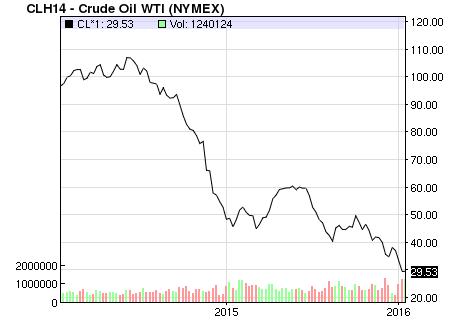
The biggest shakeup regarding this situation is the Iranian oil. OPEC affirmed its production amount of over 31 million barrels per day back in early December 2015. That number is drastically larger than prior outputs by OPEC in an attempt to decrease the price of oil to a level that precludes global competition (U.S. shale oil production). The recent production has increased oil supply drastically and led to a free fall in oil price. Below, one can see the absolute freefall of oil from a high of over $100 per barrel to a low of under $30 (on NYME the Feb 2016 future ended at $26.55 per barrel).
As noted prior, the oil market has been spiked with oil production, but now Iran is also going to be able to add additional oil to the market as part of the aforementioned lifting of economic sanctions. In 2014, the US Energy Information Administration estimated that Iran produces approximately 3.377 million barrels per day. Now without sanctions, Iran estimates that number will increase by 500,000 to 1,000,000 barrels per day (a 14.8% and 29.6% in Iran’s oil production respectively). In the world production, this increase is only .54% to 1.08% (even less based on the 2015 oil production increases from OPEC).
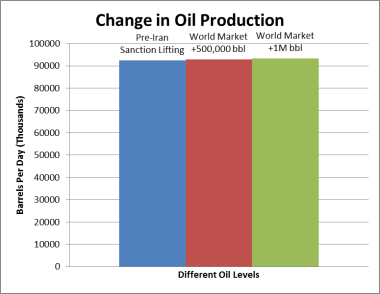
With less than a 1% increase in world oil production, why is the oil market reacting in such a passionate way?
Markets seem to be naturally irrational. For example, there does not seem to be rationale for a near 10% fall in oil prices due to the recent Iranian announcement that will only alter oil production by less than 1%; therefore, it would seem that the oil market is reacting to public opinion rather than actual analysis. Alan Blinder, a Princeton University Economist, shares my sentiments in his opinion article “Markets Are Scaring Themselves” found here in the Wall Street Journal .
Ultimately, the global-Iranian relationships seem to be increasing, the oil market seems to be overreacting and sadly, citizens across the world (especially in the U.S.) are once again buying bigger gas-guzzling cars.
 thereisnopeak.com
One thought on “Overdramatizing Iranian Oil”