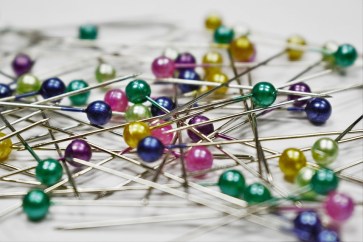
 The founder of modern economics, Adam Smith, argued for specialization during his discussion of the pin factory. Smith noted that individuals working in a factory were able to make somewhere between one and twenty pins in a day; however, if there were to be a group of pin makers who would specialize in each section of the pin making process, the production would go much quicker. How quick? Smith estimated that ten people working alone could make between 10 and 200 pins a day, but with ten people uniquely specialized to contribute to each step of the process, there could be around 48,000 pins produced a day.
This post has absolutely nothing to do with Pins, but everything to do with specialization. In Smith’s example, someone would melt the metal, someone would shape the metal, someone would make the pin head, someone would attach the pin head and so on. One caveat Smith noted regarding the specialization premise is the tendency for us humans to become bored. Unique specialization becomes so repetitive that people find themselves losing focus, and not performing at their best.
I fear that a different downside of specialization has permeated our everyday lives. We have become so dependent upon one another for basic tasks that we act as if we are specialized to the utmost possible degree; thus, we are incapable of performing rudimentary tasks that others do for us.
The impetus for this post was a discussion with my friend, who works on Paynter Family Farm* in Crestline, OH. Rather than sipping margaritas on some bikini clad beach, I spent my vacation moving hay bales, processing corn, building chicken pens and feeding animals. The two of us began discussing how humorous it was that I had never completed such tasks in my life, whereas he had completed these tasks almost daily for the past two decades.
It boils down to specialization. The majority of society has become so specialized in corporate America, teacher-land, lawyer-world or work-ville, that we fail to find adequate time to de-specialize and learn about the vast world in which we reside. We fail to see the process in which our bellies are fed, our cars drive, and our hair is cut. We are Neanderthals at best with a basic understanding of some of the most useful points in life.
I am guilty to say the least, for I do not know how to change the oil on my car, let alone a tire if it were to go flat; I would have to get out the owner’s manual and hope for the best as I flip through the black and white pages of diagrams. On the contrary, some of my close friends could fix the engine in a matter of minutes. I do not know how to grow food well (evident by my basil plant being on life support every other day), but as I noted above, I watched a family of farmers grow food without any bug repellant, weed killer or anything of the sort to ensure their food stayed up to organic standards. I cannot cut the hair of another person, unless that person wants to be bald or have a cubist look. Remedial tasks are nearly impossible due to my degree of specialization.
Some degree of specialization is required or we would be unable to function in the modern society at which we live; however, the complete ignorance of the tasks of others becomes problematic. Thus, I hypothesize that we are unable to complete basic tasks due to extreme specialization compounded over many years of training. A perfect example of this lack of task completion can be found through my educational training, which has enabled me to comprehend differential calculus, but not crop cultivation.
I am the product of a long and lengthy process of unique specialization; a process for which I am working to break free from.
*A special thanks to Adam Paynter for help with this post and welcoming me to Paynter Family Farm; the first step in a journey to free myself from the adverse pull of specialization.
 thereisnopeak.com