 In his inaugural address, President Franklin D. Roosevelt said the famous words, “…the only thing we have to fear is fear itself…” It is one of the most quoted lines in history; however, the next part of his speech is commonly overlooked: “…nameless, unreasoning, unjustified terror which paralyzes needed efforts to convert retreat into advance.” The “needed efforts” that FDR spoke of can be epitomized by the exertion of humanity to lift the comforts of normality and push forward with new technological progress. Society needs to embrace the newness of progress or we will prevent what economist Joseph Schumpeter called “creative destruction.” Creative destruction is the process of new innovation replacing the old; it is the conversion of retreating into advancing.
An example of creative destruction can be found through the story of Borders Group. The Borders bookstores that dotted the shopping centers across America closed down in 2011 after the rise of Amazon.com. Amazon was, and still is, creatively destroying the need for brick and mortar stores.
However, as Amazon progresses and creatively destroys through technology, walls are being built to inhibiting such progress by stoking the fire of fear. For example, the drastic measures of the Federal Aviation Administration (FAA) to limit drone traffic will do nothing but inhibit Amazon’s ground-breaking delivery system; thus, the FAA is using the fear of drones to build a wall and subsequently prevent the progress of creative destruction.
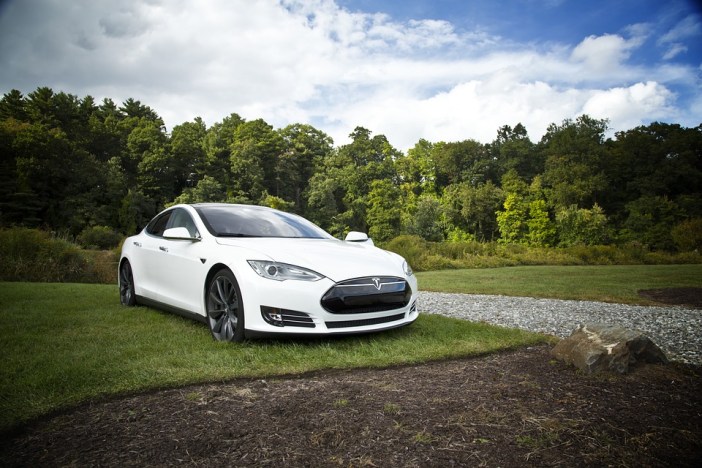
The most recent “wall-building” frenzy was sparked on May 7th, 2016 when Joshua Brown died behind the wheel of a Tesla S that was using “autopilot.” This accident was the first of its kind in the sense that no autopilot driven car had crashed before. Needless to say, news channels and the internet thrust the story into the national spotlight as soon as it was made public.
In the company’s online press release for the software package that contained autopilot, the company warned against the behavior of Brown by clearly stating “Tesla requires drivers to remain engaged and aware when Autosteer is enabled. Drivers must keep their hands on the steering wheel.” Brown chose not to heed this warning and perished as a result. However, this accident will only supply fresh kindling for the fearful fire of driverless technology; some may even call to end the newest phase of creative destruction being spearheaded by Tesla.
We fall victim to the fear caused by drastic new stories, which create the illusion of danger. For example, in 2015, the National Safety Council estimated 38,300 vehicle fatalities while the International Air Transport Association concluded a meager 136 U.S. airline fatalities. Though vehicle fatalities are nearly 300 times more frequent, far more humans fear flying than driving. Some have argued that this logical anomaly is fueled by the gruesomeness of the accidents in regards to plane failures. The gruesomeness is further complicated by the sheer lack of frequency that makes plane crashes seem exciting and worthy of news; therefore, people fear the low frequency, but highly mentioned crashes.
It is these highly mentioned crashes that will plague Tesla. In a December 2015 Fortune Magazine interview, Elon Musk, founder and CEO of Tesla Motors, stated “We’re going to end up with complete autonomy, and I think we will have complete autonomy in approximately two years.” However, that two-year horizon is going to face the setback of this glamorized accident driven phobia; therefore, the future autopilot accidents will preclude Musk’s audacious vision of fully driverless cars from coming through.
The investigation of the May 7th crash is being conducted by the National Highway Transportation Safety Administration (NHTSA). The NHTSA, which is responsible for “setting and enforcing safety performance standards,” could hypothetically ban the autopilot feature; thus, unanimously precluding creative destruction and technological advancement.
Let us imagine a world in which the NHTSA finds no problem with Tesla’s autopilot feature and let us assume that by 2018, Tesla releases fully driverless cars (an audacious, but plausible timeline). Then, the death of Mr. Brown will be the first of many and most likely the most insignificant. Tesla’s technology will inherently decrease the number of deaths that occur while driving in the United States. For example, driverless cars could drastically reduce drunk driving deaths as individuals could solely rely on the car to do the driving while inebriated.
However, computer programs are never perfect in the sense that autopilot features will not eradicate vehicle fatalities. The true test of Tesla and driverless cars will come from a mistake in which an innocent victim is killed, but worst of all, maybe, just maybe, with full human operation of the vehicle, the victim would have survived. Perhaps the sensor in the car malfunctions as a child is playing in the street, or possibly a future two vehicle accident will involve the death or severe injury of a toddler. Such bleak forecasts are inevitable; it will be in these instances that our willingness for technological progress will be truly tested. We will have to set aside the infrequent, but tragic deaths, for the overall decrease in the quantity of vehicle fatalities that automation can bring; however, with the media frenzy that will ensue, such a task will be monumental.
To help surmount this monumental task, we must silence the human tendency of illusory superiority, also known as the Dunning-Kruger Effect. The Dunning-Kruger Effect is a cognitive bias in which one wrongly believes they are better than others. One of the most famous examples of the effect was published in the Swedish Psychology Journal and found 93% of Americans consider themselves above the 50th percentile in driving ability. Of course, such a number is mathematically impossible, but nevertheless, this is the effect that will destroy Tesla. People will cry from the rooftops that they would not have caused the death of the child in the street because they would have easily swerved. They would not be the cause of the two vehicle accident because certainly they would not be texting, talking on the phone, playing with the radio, eating or engaging in any other act that could create less than optimal driver reactions. No, a human driver would never be so careless, regardless of the 38,300 people that died last year. Needless to say, the Dunning Kruger effect will be in full swing when the innocent victim perishes.
The death of Joshua Brown is the first of many associated with driverless cars. For society to be comfortable proceeding down this automated path, we must somehow have our natural biases and phobias be truncated, allowing for driverless technology to help correct for our decision making in the long run. I only hope our emotions will be able to stomach the short term obstacles as we seek to “convert retreat into advance.”
 thereisnopeak.com